Benchmark
legendary ships a reproducible, four-arm benchmark rather than asking you to take a claim on trust. The methodology is pre-registered and committed before any run, so results cannot be retro-fitted to a conclusion.
What it measures
Two sessions with separate context - the amnesia boundary is the thing under test:
- Session 1 fixes a concurrency bug in
sync/worker.py. The plausible fix (wrapping writes inBEGIN TRANSACTION) does not work; the working fix isPRAGMA busy_timeout. The agent learns this the hard way. - Session 2, with fresh context, fixes the same class of bug in
sync/reporter.py. An agent with no memory of session 1 tends to retry the approach that already failed.
The fixture is validated three ways: broken -> both tests fail;
busy_timeout -> both pass; BEGIN TRANSACTION -> still fails.
Arms
| Arm | Configuration |
|---|---|
baseline |
no memory, no graph tooling |
graphify |
Graphify MCP only |
legendary |
legendary MCP only |
both |
Graphify + legendary |
Graphify is included because it is the nearest well-known tool, and because the
honest hypothesis is that the two are complementary: Graphify models code
structure, legendary remembers decisions and failures. If both wins, that is
what gets published.
Metrics
tokens_total- input + cache + output across both sessionscost_usd,duration_s,num_turnsrepeated_failure- did session 2 reintroduce the known-bad pattern? Detected deterministically from the diff, not by an LLM judge.correct- does the test suite pass at the end?
Running it
uv run python bench/run_bench.py -n 5 --workdir /tmp/legbench
uv run python bench/report.py
This costs real API credits (40 agent sessions at the default settings) and is deliberately excluded from CI.
Results (n=10 per arm, 2026-08-21)
legendary reduced rediscovery ~9.5x. Zero trials excluded; both channels activated in 10/10 legendary trials.
| arm | n | median s2 quirk hits | range | s2 cost | s2 turns | s2 correct | |---|---|---|---|---|---|---|---| | baseline | 10 | 9.5 | 1-15 | $0.60 | 16 | 10/10 | | legendary | 10 | 1.0 | 0-2 | $0.60 | 14 | 10/10 |
Raw per-trial counts:
baseline:  [1, 6, 7, 7, 9, 10, 10, 12, 12, 15]   -> 89 wasted requests
legendary: [0, 1, 1, 1, 1, 1,  2,  2,  2,  2]    -> 13
Exact permutation test (one-sided, 20k resamples): p = 0.00015. The distributions barely touch - only baseline's best trial (1) reaches legendary's worst (2). One legendary trial rediscovered the quirk zero times: it recalled what the earlier session learned and got the request right first try.
Scenario 2 result: legendary wins (n=10)
(table and analysis above)
Ablation: RETRACTED (2026-08-21)
We published a conclusion here that "the hooks are not what wins." It is withdrawn. Both arms were misconfigured, in ways that made the comparison meaningless. The contribution of the hooks is unknown, not zero.
Why each arm was invalid
legendary_hooks_only never stored anything. The arm was defined as
"hooks, no MCP" — but legendary has no write path other than the MCP remember
tool (there is no remember CLI subcommand). With MCP absent the store could
never be populated: wrote_memory: false in 10/10 trials, and the preserved
trial repos contain no memories/ directory at all. It was also broken a second
way: reset_repo's keep-list tested "legendary" in ARMS[arm], which is False
for ["hook_only"], so git clean deleted .legendary/ at the session
boundary regardless. The arm measured hooks over a permanently empty store —
which is baseline.
legendary_recall_only was not hook-free. legendary init installs both
hooks unconditionally, so that arm had them too, and surface demonstrably
fired in 9/9 valid trials (.surfaced-* caches present in the preserved repos,
session ids matching session 2). The harness reported surface_fired: None
only because that field was gated on the arm's label rather than observed
from disk.
So "recall-only" and "full legendary" were the same configuration. The p=0.83 between them is two identical setups agreeing — a reproducibility check, not an ablation.
The process failure, which matters more than the arms
The harness did catch this: all ten hooks_only records carry
activation_failures: ["no_hook_fired"]. But report.py's ARM_ORDER listed
only baseline and legendary, so ablation arms never passed through the
exclusion gate — and the median we published was computed by hand, outside the
gate that had already rejected every trial in that arm.
The guard existed and worked. The analysis went around it.
Also corrected: the both arm is n=4, not n=10
6 of its 10 trials carry no_memory_written_in_s1. The earlier table reported
n=10. Its median (1.0) is unchanged on the 4 valid trials, but the sample size
was overstated.
Offline hook replay (free, n=10)
Instead of buying another arm, we replayed both hooks offline against the
archived trials — surface and guard are pure functions of (store,
hook-input), and every input was preserved. bench/replay_hooks.py:
| would have fired | |
|---|---|
surface |
9/10 trials |
guard |
9/10 trials |
(Trial 9 wrote no memory at all, so nothing could fire.)
So "the hooks never fire" is not the explanation for anything. Both channels engage on this task.
Three caveats, because this is a replay and not a measurement:
- It uses the fixed matcher. The trials themselves ran against published
0.2.0, whose
json.dumpshaystack could not match quoted or multiline triggers, so what did fire during those trials was likely less. - Firing is not helping. The replay shows delivery, not effect.
- Look at what
guardmatched:test_billing_reconciliation— the old test name, meaning the agent re-ran the session-1 test. That is the occurrence-specific-trigger problem, visible in real data.
The honest position remains: which channel drives the result is unmeasured. What we now know is that both fire, so any explanation resting on "the hooks are inert" is wrong.
What is unaffected
The mem0 comparison stands: baseline, mem0 and legendary were all
correctly configured, and nothing in this retraction touches them. legendary
median 1.0 vs mem0 11.5 vs baseline 9.5, p=0.007.
Raw data for every trial, including the invalid ones, is preserved under
bench/results/artifacts/.
Head-to-head vs mem0 (n=10 per arm, same scenario)
The first comparison against a memory tool people actually use, rather than against nothing.
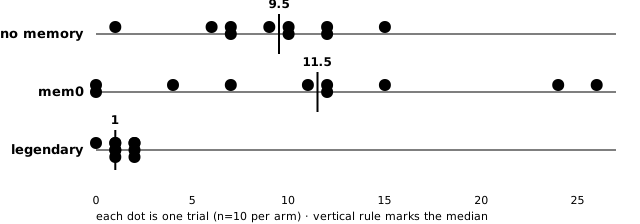
| arm | n | median rediscoveries | range | s2 cost | s2 correct |
|---|---|---|---|---|---|
| baseline | 10 | 9.5 | 1-15 | $0.60 | 10/10 |
| mem0 | 10 | 11.5 | 0-26 | $0.77 | 10/10 |
| legendary | 10 | 1.0 | 0-2 | $0.60 | 10/10 |
baseline  [1, 6, 7, 7, 9, 10, 10, 12, 12, 15]   = 89 wasted requests
mem0      [0, 0, 4, 7, 11, 12, 12, 15, 24, 26]  = 111
legendary [0, 1, 1, 1, 1, 1, 2, 2, 2, 2]        = 13
- legendary vs mem0: p = 0.00705
- mem0 vs baseline: p = 0.695 - mem0 was statistically indistinguishable from having no memory at all on this task, while costing 28% more per session.
Does running both together help? No.
| arm | n | median | raw | total rediscoveries |
|---|---|---|---|---|
| mem0 | 10 | 11.5 | 111 | |
| both | 4 (6 excluded) | 1.0 | [0,0,1,1,1,1,5,5,9,20] (all 10 shown; 6 failed activation) |
43 |
| legendary | 10 | 1.0 | [0,1,1,1,1,1,2,2,2,2] |
13 |
Same median, but no measurable benefit and clearly worse stability: legendary alone never exceeded 2 rediscoveries in any trial, while the combination produced a 9 and a 20 - worse than baseline's worst trial. Total waste more than tripled.
both vs legendary is p = 0.36, so we do not claim combining is worse.
We claim it does not help. Adding legendary to mem0, by contrast, does help
significantly (p = 0.048).
Verdict: legendary is standalone. There is no memory tool to bolt it onto, and no benefit measured from doing so.
Two explanations we tested and rejected
"mem0 never got used." False. Counting actual tool invocations (not ToolSearch lookups - an early count of ours conflated the two), mem0 stored in 10/10 trials and was searched in 9/10. It was used as intended.
"mem0 stored worse knowledge." Also false. Its memories were correct and detailed, capturing the full service contract including the quirk. Content was not the problem.
What differed - and a correction
An earlier version of this page claimed legendary's guard hook "fired in
10/10 trials, pushing the fix back at the moment the failure recurred." That
claim went further than the evidence supports, and is withdrawn.
What the data actually shows:
- A push hook fired in 10/10 legendary trials (
hook_fired), butsurfaceandguardwrite to the same.surfaced-<session>cache file, so that flag cannot distinguish which one ran. - The harness records only assistant messages, so hook-injected context does not appear in the saved transcripts at all. We cannot see what was delivered.
recallwas actively called in 9/10 legendary trials. In the one trial where it was not (trial 8), rediscoveries were still low (2), which is suggestive of a hook contributing - but a single trial is not evidence.
So the honest statement is: legendary's combination of push hooks plus agent-initiated recall outperformed mem0's search-only channel, and we have not isolated which part is responsible. The delivery-timing explanation remains our hypothesis, not a measured result.
What is measured and not in doubt: both tools stored correct knowledge, both were used as intended, and the outcomes differed by an order of magnitude.
Deciding what earns its cost
Attribution requires an ablation - separate arms for guard-only, surface-only, and MCP-only - which has not been run. Until it is, we cannot say which capability pays for itself, and we will not imply otherwise. Scenario 3 already showed the whole package costing 54% more for no benefit when the knowledge was not needed; a per-channel breakdown is the next thing worth measuring. mem0 is a mature tool with capabilities legendary does not have - semantic search, cross-application memory, scale. On this task, none of that substituted for arriving at the right moment.
Fairness
- The mem0 adapter is ours and is published (
bench/mem0_mcp.py) for audit: two tools mapping ontoMemory.add/Memory.search, no tuning either way. - We pinned current Gemini models because mem0's built-in defaults point at a retired one. That change helps mem0.
- mem0 got the same activation assertion as every arm; zero trials excluded.
- baseline and legendary numbers are the same n=10 runs reported above, on the same fixture and machine. Only the mem0 arm was run fresh.
- We wrote legendary. Anyone can re-run this: the harness, adapter, fixture, and every transcript are committed.
Scenario 3 result: legendary LOSES (n=10)
A second scenario, deliberately different: negative knowledge about our own code (an approach tried and reverted), measured by authorship in the git diff rather than a server log.
| arm | n | median s2 rediscoveries | s2 turns | s2 cost | s2 correct |
|---|---|---|---|---|---|
| baseline | 10 | 0.0 | 8 | $0.32 | 10/10 |
| legendary | 9 (1 excluded) | 0.0 | 10 | $0.50 | 9/9 |
The metric never fired for either arm. No agent wrote the dead-end pattern even once. And legendary cost 56% more per session-2 ($0.50 vs $0.32), and 54% more across the whole run ($11.40 vs $7.40), for no measurable benefit.
Why it failed - a design error in the scenario, not a defect in the tool
The agent went straight to ThreadPoolExecutor(max_workers=...). It never
attempted thread-per-key, so there was nothing to remember and nothing to
avoid.
The mistake was ours: "use a bounded pool rather than unbounded threads" is standard knowledge the model already has. We made it absent from the repository but not absent from the model's priors. Scenario 2 works because "this particular service silently discards JSON floats" is arbitrary - it cannot be guessed, only observed.
This adds a fifth bar every scenario must clear: the knowledge must be unavailable to the model, not merely absent from the repo.
What the two results say together
This is the more useful finding, and more honest than a clean sweep:
| when the needed knowledge is... | legendary |
|---|---|
| arbitrary, discoverable only by experiment (scenario 2) | 9.5x fewer rediscoveries, p=0.00015 |
| already in the model's priors (scenario 3) | ~54% more expensive, no benefit |
legendary is not free. It costs real tokens on every session, and on tasks where the model already knows the answer that cost buys nothing. It pays off when your codebase has arbitrary, hard-won, environment-specific knowledge - which is exactly the knowledge that has no home in a comment or a README.
Use it for the second kind of problem. We would rather say that than sell it as a universal win.
What this does and does not show
Does: on knowledge that provably cannot be recovered from the repository, pushed and verified memory stops an agent re-deriving what it already learned. That is measured behaviorally, from the mock server's own request log, on a metric that cannot match repository text.
Does not: show a cost or token win. Median session-2 cost was identical ($0.60 vs $0.60) and turns barely moved (16 vs 14). legendary spent its saved effort inside the same budget rather than finishing cheaper. Anyone quoting this as "legendary makes agents cheaper" is misreading it.
Correctness was unaffected - 10/10 in both arms. This task is solvable either way; the difference is how much waste it takes.
Caveats
- One scenario, one model, one day. External validity is unproven.
- Operator config contaminated every trial (see the known limitation in
bench/README.md):CLAUDE_CONFIG_DIRisolation breaks keychain auth, so the operator's skills were present in both arms. Each trial recordsoperator_env; results do not represent a stock agent. - A harness bug was fixed mid-run. The activation assertion read the init
event's tool list, which does not enumerate MCP tools, so it was excluding
legendary trials in which
used_recallandused_rememberwere both recorded and memories existed on disk. The fix recomputes activation from observed use, using data captured before the change. Both the bug and the fix are in git history. It moved the result in legendary's favour, so it deserves the scrutiny. - We wrote legendary. The methodology was pre-registered and committed before the run; anyone can re-run it.
Raw per-trial JSON and full session transcripts for all 20 trials are in
bench/results/.
History
The v1 benchmark reported the opposite (legendary costing more) and was retracted for measuring nothing - its fixture let session 2 read session 1's fix, and its headline metric matched strings in the fixture's own source. That retraction, and the four defects behind it, are what this design was built to make impossible.