cachemaxxing
Stop paying full price for the same tokens.
Anthropic, OpenAI and Gemini bill a repeated prompt prefix at a fraction of the input price, but only when the bytes really repeat. cachemaxxing finds where they don't, tells you what it costs, and lays your prompts out so they do.
- Measure.
usage()turns every provider's response into the same numbers: input, cache read, cache write, output, estimated $ and hit rate.cachemaxxing reporttotals them per call site. - Diagnose. Give
Statseach request and it tells you, as soon as it happens, the first byte where a request stopped repeating the previous one, why (a timestamp, a UUID, tool order, JSON key order) and how to fix it.cachemaxxing reportprints the same from a log. - Fix.
Promptorders your prompt from most to least stable and places each provider's cache markers for you.
from openai import OpenAI
from cachemaxxing import Prompt, usage

chat = [
    {"role": "system", "content": SYSTEM},  # your long, fixed instructions: cached
    {"role": "user", "content": "How do I reset my router?"},
]
p = Prompt(call_site="support.answer").messages(chat)  # call_site: any name for this call, used in reports

resp = OpenAI().chat.completions.create(**p.openai_chat("gpt-6-luna"))
# same p: anthropic.messages.create(max_tokens=1024, **p.anthropic("claude-haiku-5-5"))
#         genai_client.models.generate_content(**p.gemini("gemini-3.8-flash"))

u = usage(resp)
print(f"{u.hit_rate:.0%} of input from cache, ~${u.est_cost or 0:.4f}")
The system prompt and the conversation so far get the provider's cache markers, so each turn reads everything before the new question from cache. For tools, RAG chunks or a timestamp, build the prompt from parts: p.tools(TOOLS).system(SYSTEM).history(chat).retrieved(chunks).user(question). The quickstart shows where the markers go, and the exact request.
It is a thin library, not a proxy: you keep your own SDK client.
New here? The tutorial takes ten minutes, from a broken cache to a fixed one.
Benchmark
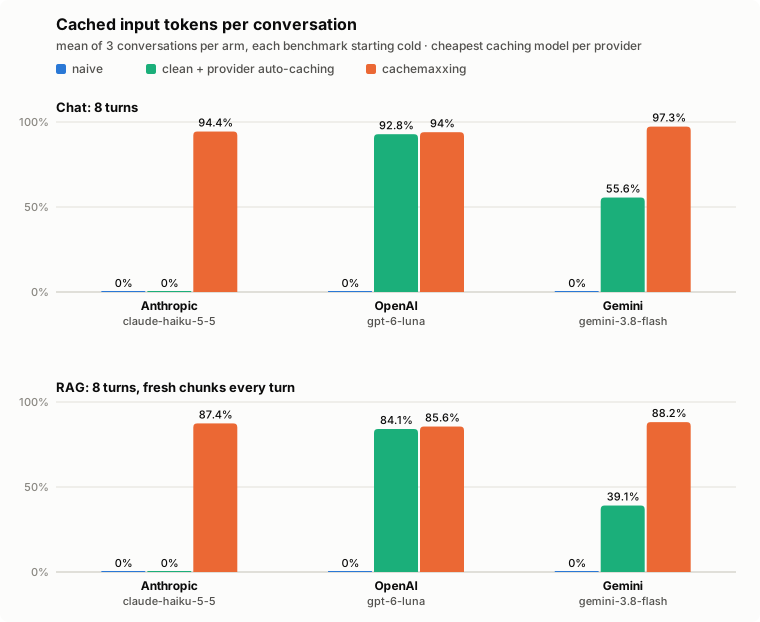
- Against a sloppy app (the naive arm, chat and RAG): input cost is 76–88% lower on every model.
- Against a clean prompt using the provider's own one-line caching, it depends on the provider:
- Anthropic: automatic caching puts its single cache entry after the per-turn context (time, request id, retrieved chunks). That entry changes every turn, so the app pays the 1.25× write premium on every call and reads nothing back. That is 0% cached, and dearer than not caching at all. A breakpoint after the static prompt, which cachemaxxing places, fixes it: 82–89% cheaper.
- Gemini: implicit caching is best-effort and reached 39–56%. The explicit cache cachemaxxing creates when
should_cache()says it pays reached 88–97%, 62–67% cheaper, with creation and storage included. - OpenAI: implicit caching already finds a stable prefix, and cachemaxxing is only 6–19% cheaper. On OpenAI the win is fixing the habits, plus the measuring tools.
- LangChain agents:
CacheMiddlewareties LangChain'sAnthropicPromptCachingMiddlewareon Anthropic and the default agent on OpenAI. It adds one setup for every provider and per-call-site measurement, not extra savings.
| Workload | Model | naive | clean + provider auto-caching | cachemaxxing | vs naive | vs clean |
|---|---|---|---|---|---|---|
| chat | claude-haiku-5-5 |
0% · $0.0090 | 0% · $0.0112 | 94.4% · $0.0014 | 84% cheaper | 87% cheaper |
| chat | gpt-6-luna |
0% · $0.0068 | 92.8% · $0.0009 | 94% · $0.0009 | 87% cheaper | 6% cheaper |
| chat | gemini-3.8-flash |
0% · $0.0468 | 55.6% · $0.0236 | 97.3% · $0.0077 | 83% cheaper | 67% cheaper |
| chat | claude-sonnet-5-5 |
0% · $0.1791 | 0% · $0.2232 | 92.4% · $0.0247 | 86% cheaper | 89% cheaper |
| chat | gpt-6.1-sol |
0% · $0.1389 | 88.4% · $0.0209 | 91% · $0.0168 | 88% cheaper | 19% cheaper |
| rag | claude-haiku-5-5 |
0% · $0.0069 | 0% · $0.0086 | 87.4% · $0.0015 | 78% cheaper | 82% cheaper |
| rag | gpt-6-luna |
0% · $0.0049 | 84.1% · $0.0011 | 85.6% · $0.0010 | 80% cheaper | 15% cheaper |
| rag | gemini-3.8-flash |
0% · $0.0352 | 39.1% · $0.0226 | 88.2% · $0.0086 | 76% cheaper | 62% cheaper |
| agent | claude-haiku-5-5 |
0% · $0.0044 | 89.8% · $0.0010 | 89.9% · $0.0009 | 78% cheaper | 1% cheaper |
| agent | gpt-6-luna |
90.4% · $0.0006 | — | 90.1% · $0.0006 | 2% dearer | — |
Cells: cached share of input tokens · estimated input cost per conversation at list price (cache writes and explicit-cache storage included; output excluded, since answer length varies between runs regardless of caching).
Setup: 8-turn conversations (agents: 3 questions with a tool call), 3 customers per arm. Every arm starts from a cold cache with its own prompt, so no arm reads another's entries. The naive arm has the four habits: a timestamp and request id at the top of the system prompt, tool order that varies, JSON key order that varies, and history re-rendered every turn; in RAG, chunks also go in the system prompt. The clean arm has the same content laid out well, with Anthropic's top-level cache_control or OpenAI's and Gemini's default implicit caching. Data: benchmarks/results/, run 2026-10-30. Rerun with uv run --env-file .env python benchmarks/bench_<provider>.py --workload chat|rag and benchmarks/bench_agent.py; the table comes from benchmarks/summary.py.
Install
pip install cachemaxxing
uv add cachemaxxing
There are no runtime dependencies. Extras pull in a provider SDK: cachemaxxing[anthropic], [openai], [gemini], [litellm].
Next: the quickstart.